DJasonFleming
Movies • Books • Writing
The Clones of Bruce Lee, 1980
July 26, 2024
post photo preview
Copyright 2024 D. Jason Fleming, CC BY-SA 4.0

Second in a series of posts reviewing Severin Films's box set Game of Clones: Bruceploitation Volume 1.

Sorry it's taking so long to get these things up. Life is a bit hectic and looks unlikely to get much less so soon. Hopefully, I can write these up a bit more quickly from here on out.


First and most importantly, gratuitous boobs. Nice gratuitous boobs, even. Because it's 1980.

That out of the way, here we have another example of pornography plotting. Things happen in the story because that's what the producers wanted to happen, and how it fits into any kind of story is, at best, a tertiary consideration.

So, Bruce Lee dies. His body is taken to a hospital, then brought over to a mad scientist (played by an American who played the bad guy in Way of the Dragon) so that he can make several clones of Bruce for the government. (Which government is not made explicit, but seems pretty clearly that of Great Britain, what with Hong Kong being a Brit colony at the time.) Why? Um, well, for "missions". Why can't they just have trained agents do these missions, why go to the bother of making and raising clones (yeah, no, no "raising", they're fully grown because low budget movie logic)? As the Critical Drinker would say, Don't Know!

So three clones are made, and two of them have a Bruceploitation track record, Bruce Le and Dragon Lee. Bruce Lai had done, maybe, two Bruceploitation flicks before this one, making him the rookie of the bunch. (And a fourth Bruce shows up in a mid-movie sequence, Bruce Thai in, of course, Thailand.) They get trained up, including by Bolo Yeung, and then get tasked to take out various criminals. The trip to Thailand includes the most gratuitous sidetrip ever, where the two Bruces go to a nude beach, see nearly a dozen topless Thai ladies posing for the cameras, then decide, nah, they're going to go do something else before taking down the drug lord.

So, after two or three random missions, Mad Scientist Guy decides to turn the Bruces against each other, so that the strongest one will be his sole servant so that he can rule the world. How? Don't Know!

Newest Bruce dies, the other two team up against Mad Scientist Guy, they win, the end.

As you might guess from the above description, the movie is bonkers, though not even close to the most bonkers movie in this set. The plot, such as it is, was clearly thrown together in haste, with a solid use of the assets the producers had at hand, and no concern at all for making it a coherent story. Again, the justification for creating three clones of Bruce Lee is, within the story, a bit thin. Your entire reason for making the movie, and you don't even work out a reason inside of the story? And then you make the entire second act random missions that could be anything, without any real tie to the characters or the plot? It's hilarious, and entertaining, doesn't make a lick of sense, and pretty clearly was written at speed to fit the elements available. Probably the night before each day's shooting.


community logo
Join the DJasonFleming Community
To read more articles like this, sign up and join my community today
0
What else you may like…
Posts
Articles
Well, this is going to make the con a bit "interesting"...
post photo preview
Inspiration

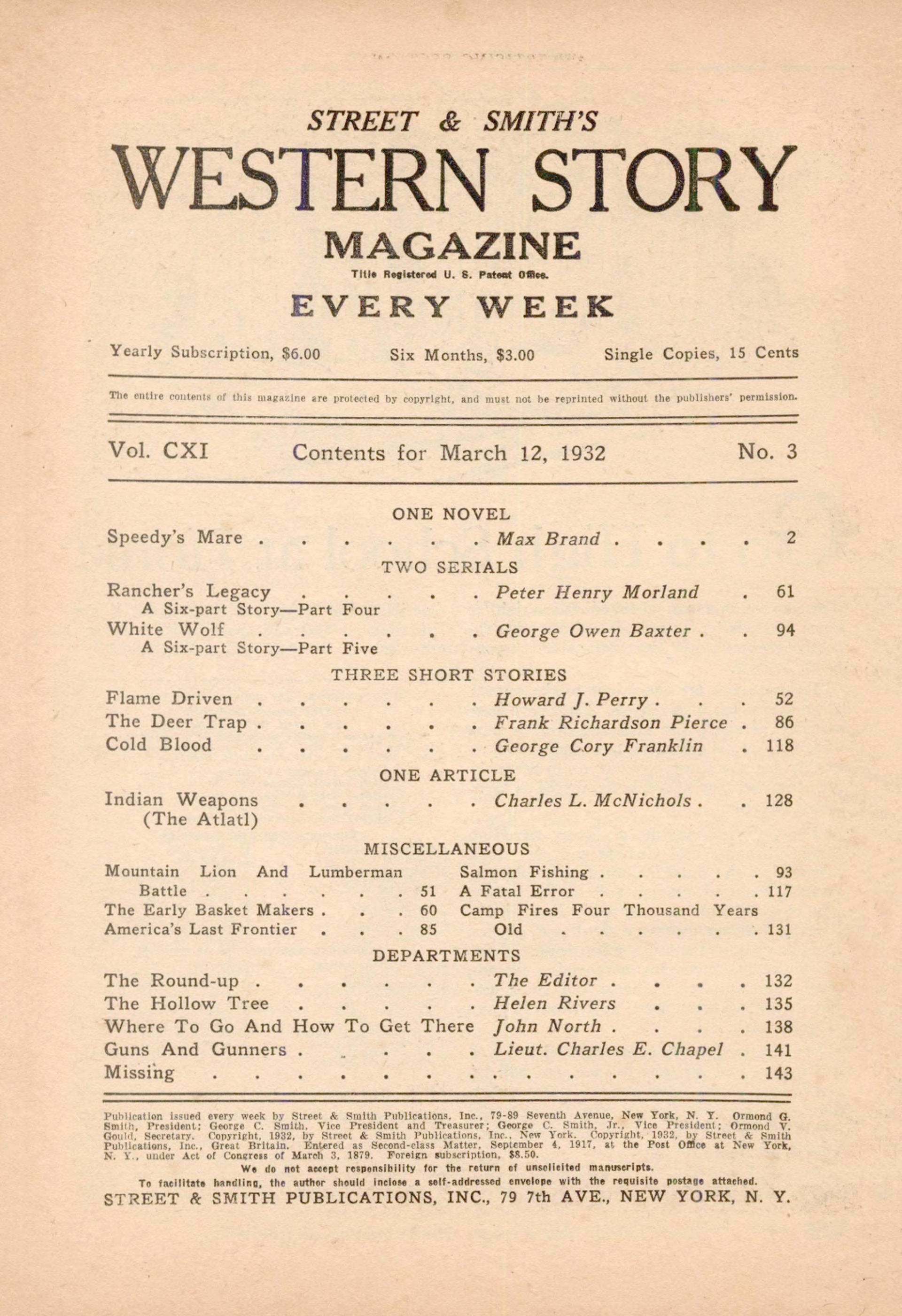
Here is the Table of Contents for an issue of Western Story Weekly from 1932.

Can you see what's funny and inspiring about it?

No?

The first three authors are all one author. Max Brand, Peter Henry Morland and George Owen Baxter were (just a few of the) pen names of Frederick Schiller Faust. That magnificent so-and-so was not only one of the best pulp writers, he wrote so stinking fast that he could take up more than half the issue of a weekly pulp, and do it on the regular.

post photo preview
Free Culture Art

I generate a lot of AI art for potential book covers. Much of it will never get used, so I'm sharing things here that I have no plans for, under the Creative Commons Attribution-ShareAlike 4.0 (https://creativecommons.org/licenses/by-sa/4.0/ ) International License. One a day, every day, for as long as I feel like it.

(Cross-posted to Minds (https://www.minds.com/newsfeed/1591570775834365956 ).)

post photo preview
post photo preview
Promises and Expectations
or: Steven Spielberg Ought To Know Better

Steven Spielberg's decline as a filmmaker has been sad to witness.

It was, perhaps, inevitable. When he was at the height of his powers, he got no respect from the "important" people, because he was commercially successful. I would have hoped that his success with Schindler's List might have satiated his craving for prestige and respect.

But ever since, his career has evinced a strange set of motivations: chasing even more prestige and respect from the elites (Amistad, Munich); experiments in craft that seem to have no genuine heart, a quality that his earliest films had more than almost anybody else's (AI: Artificial Intelligence, Warhorse, The Terminal); and movies he made for personal reasons (Saving Private Ryan, Catch Me If You Can, Bridge of Spies). 

While some of these movies are quite good, not one of them really measures up to what anyone in Generation X thinks of when they think "a Steven Spielberg movie".

(I know that Saving Private Ryan is beloved, but the film is a mess; to be sure, it is a mess with brilliance in it, especially the opening sequence of the Normandy landings, but still very much a mess.)

Now we have Disclosure Day (which I've not seen, and likely will not), and not only is it a dud, it is a clumsy dud. The title alone demonstrates the failure of the film. The title is the climax, and thus a "spoiler".

That's akin to making Jaws with only one shark attack, at the very end of the film.

If Mel Gibson had made The Passion of the Christ exactly as he did, but titled it The Resurrection, that would be the same sort of failure.

Or, in internet meme terms, it's the Surf Dracula problem in feature film form.

When you title your film Disclosure Day, you imply that the named day will happen in the first act, and the rest of the film will deal with the effects of it on whichever characters we follow. When you make that promise to the audience, but deliver instead a two and a half hour chase film that only ends with the disclosure, with no exploration of the consequences of it, you have cheated the audience and confessed that you no longer have the imagination that was once your stock in trade.

Spielberg used to understand how to set audience expectations, and how to deliver on the promises made to the audience. He was the definitive crowd-pleasing director. I think his taking to heart the disdain that the literati have for clarity and popularity poisoned his soul. Which is a shame.

Read full Article
post photo preview
A Gift of Fire
In which the editor geeks out a wee bit

In the late 1990s and early 2000s, I was in my 20s, and eBooks were (mostly) not a thing. I haunted book stores and used book stores, and even then, finding novels that suited my tastes was rough, as the tides in traditional publishing were already going toward exclusion and gatekeeping.

I bought anything that looked "cool", with a decided prejudice toward 1980s paperback SF art, which is how I stumbled across K.W. Jeter, among many others. But finding freedom-oriented fiction of any kind was a real fight against the odds.

Except I had a secret ally.

I have been an online creature since 1993. And somewhere around 1995 or 1996, one way or another, I stumbled across the website for the Libertarian Futurist Society, and their lists of Prometheus Award winners and nominees.

Those lists were how I was finally able to dig into Poul Anderson, when previously I had bounced off of his books even though I was sure I should have been loving them. (Well, there was also an insight into his writing style that I began to grasp when I read Harvest of Stars and "No Truce With Kings" simultaneously, but that's a different story.) They were how I discovered the works of authors like J. Neil Schulman, Victor Milán, Victor Koman, and many, many others I might not have found on my own. They were how I found Ira Levin's best novel (and, interestingly, the only one never adapted into a film) This Perfect Day, which I rate above both Orwell and Huxley in terms of totalitarian dystopias.

Sure, there are plenty of writers who have been nominated, or won, whose writing I don't care for. But over the years, the Prometheus nominee list has been a reasonably reliable guide to finding books by people who either are not insane, or are insane in fascinating ways. (And, bit of inside baseball, it has been the only science fiction award that has reliably lead to increased sales for the winners, and this has been true for well over a decade.)

One excellent writer who won, before I ever got to know her, was Sarah A. Hoyt. My love of Darkship Thieves led, through a chain of circumstances too complicated and prolonged to lay out here, to her adopting me as her little brother, and fatefully informing me that I am a good editor. (Seriously, I had no idea.) I've now been her main structural editor for eleven years, have done indie editing on and off for something like eight years, and have been Raconteur Press's lead novel editor for as long as they've been doing novels, just over a year and a half or so.

So, yeah, this is all her fault. 

Because something happened this year that I literally never imagined.

You see, the Prometheus Award Finalists for this year were announced in April. Five books made the cut, out of a total of fourteen nominations.

And I am the editor of three (!!!) of them.

I do not know if this has ever happened before. I suspect it has, simply because of the relatively narrow list of publishers willing to take on liberty-oriented fiction for most of the lifetime of the award. But I am gobsmacked that the first year anything I am associated with got nominated for anything, three (!!!) of "my" books all got nominated for the only award I care about.

I am giddy. 

Read full Article
post photo preview
Another example of why Hollywood is dying

Several years ago, Shout! Factory acquired the rights to all of Roger Corman's catalog, including his New World Pictures library.

Shout! Studios has made use of this to remake... Deathstalker.

Before I even get to my rant, problem number one is that the actor playing Deathstalker is sixty years old, and looks at least five years older. Sure, he's in great shape, and a skilled martial artist. But in no way is he believable as a warrior-barbarian, and he's a terrible choice for a lead in what they probably intend as a series, because he's only going to get older. (Unless they follow Deathstalker tradition and recast the lead role in every sequel.)

Deathstalker has no deep lore, no canon of stories or novels to adapt, just four cheesy original films which had little or no continuity, all shot in South America on the cheap to make cash from the coattails of Conan.

The only really appealing things in the original films are a plethora of unclad or scantily-clad ladies, and a certain doofy charm. This trailer lacks either. (Given the filmography of the director, the film itself may be a different matter.)

But getting a trash knockoff IP wrong in a remake isn't what set me off about this trailer.

It's the fact that they are remaking a trash IP, instead of adapting actual sword and sorcery literature. There is a lot of it, and some very good stuff is in the public domain. Even considering what's still in copyright, getting the film rights for quite a few good books or stories would not be expensive.

Gardner Fox wrote some highly entertaining Conan pastiches in his Kothar the Barbarian series, which were paperback originals, are in ebook now, and since Fox is long dead and not at all a household name, it seems likely that buying the film rights wouldn't be terribly expensive.

Henry Kuttner's excellent Elak of Atlantis stories are all in the public domain, so they would cost nothing in terms of rights. 

C. L. Moore's Jirel of Joiry is a female sword and sorcery protagonist, and all of those stories are public domain. 

The late, lamented Tanith Lee began her career with the astonishing s&s novel The Birthgrave, and it or her other early s&s books could probably be bought for a small (by Hollywood standards) price. 

Should I mention Fritz Leiber's Fafrhd and the Gray Mouser? Never adapted to my knowledge, some of the early stories are public domain, and the ones that are not should not be expensive to acquire.

And that's what set me off. There is an enormous amount of quality material that Hollywood could be adapting. Not just in sword & sorcery, but in science fiction, fantasy, and genre fiction in general. So many masters have had little or nothing adapted, the mines are rich in ore.

But no. If it's not Philip K. Dick, Frank Herbert, or something that's been remade and ripped off to death, Hollywood won't touch it. They either want to put their own stamp on things, twisting them all out of recognizeability, or just rehash a rehash that was rehashed a dozen times already.


Read full Article
See More
Available on mobile and TV devices
google store google store app store app store
google store google store app tv store app tv store amazon store amazon store roku store roku store
Powered by Locals